

Heard your child’s teacher talking about student agency and didn’t dare to ask what they meant by that? We have spoken to XCL World Academy teachers to shed light on what this concept entails for your young ones’ early years of learning.
Student agency revolves around empowering students to actively participate in their own learning journey. It involves granting children more autonomy and control over their educational experiences while offering them opportunities to contribute and provide input on important classroom decisions. By promoting student agency, teachers aim to lighten the load of learning by encouraging students to take responsibility for their educational growth.
Learning becomes a partnership between the teacher and the student. Students have a genuine voice in the class, and it helps us co-design and co-construct the learning experiences together. Although teachers have clear expectations for student behaviour, these expectations are brainstormed together with our learners to establish essential classroom agreements.
By nurturing independent learning skills and encouraging every student to take responsibility for their learning, we aim to develop students’ academic, social and emotional well-being while simultaneously focusing on international-mindedness and strong personal values. Wondering how we do that? Let us share a few examples of learning environments that stimulate your child’s well-rounded development and allow them to showcase student agency.
Collaborative design of our kindergarten learning pod
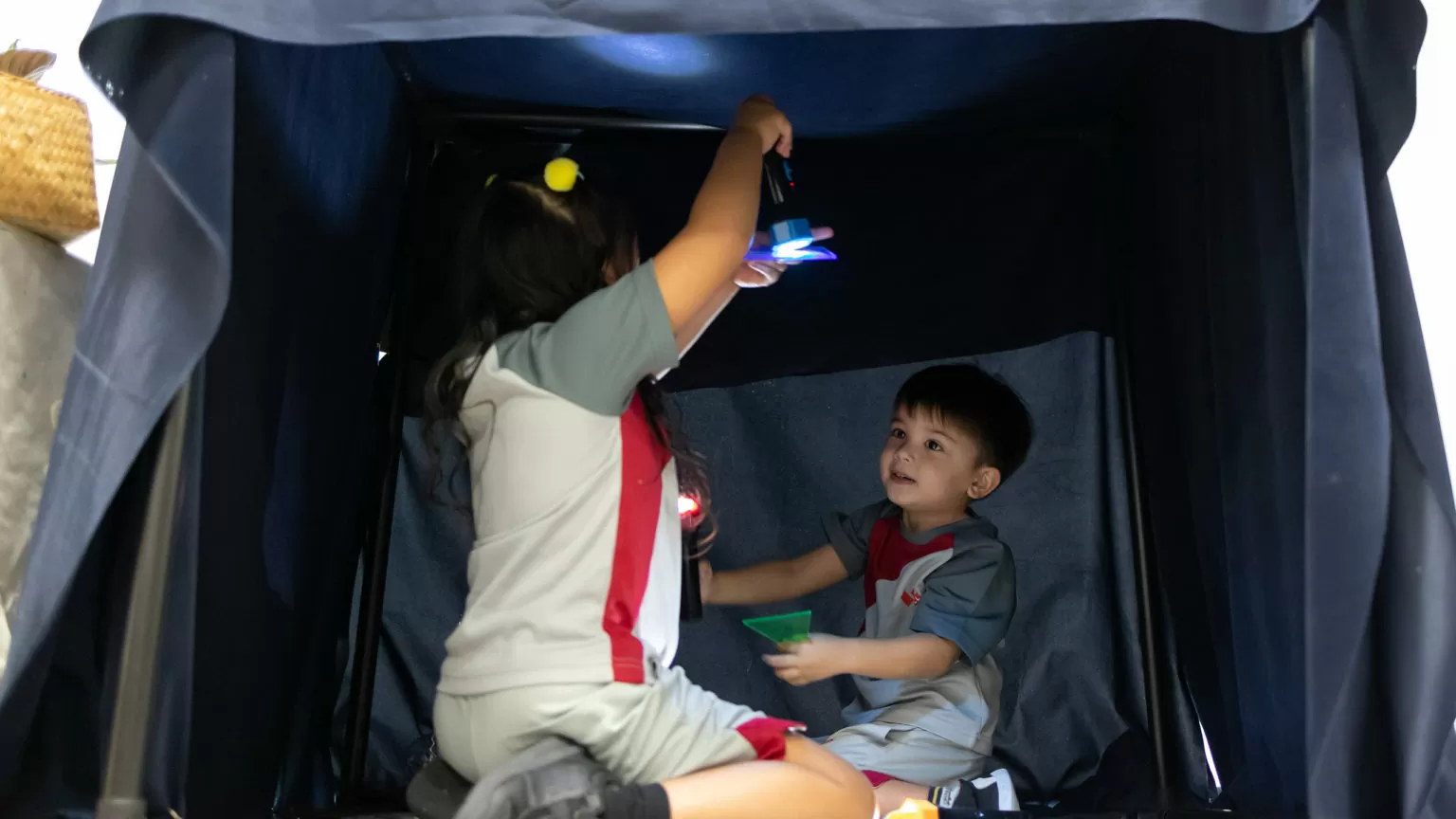
Recently, our Pre-K students were invited to share their imaginative ideas on enhancing the Learning Pod area within our kindergarten building, and their response was nothing short of remarkable! Engaging in a collaborative discussion, we explored various materials that could bring their ideas to life, and the transformative journey began.
Together, we rolled tires into a designated space, repurposed large boxes to construct a marvellous train, set up a weaving station, and curated a dedicated drawing area, among many other captivating additions. One of our students decided to set up a “Glamping” area, with two tents filled with pillows, fake grass, coffee table with chairs around it- and then, for his finishing touch, he ran to find a small plant to put on the table. He then proclaimed, “I love designing! I want to design more!” This student came up with the best design of the learning pod we have ever had. It has been amazing to see the excitement in children’s eyes and the desire to create and innovate.
Empowering learners to share their understanding
In KG1, we prioritise the importance of choice in assessing our young learners’ understanding. When posed with questions such as “What does scientist mean?” students are granted the freedom to express their comprehension through diverse forms of formative and summative assessments. They are encouraged to choose a medium that best suits their individual learning styles, allowing for a personalised and comprehensive approach.
For instance, when exploring the concept of a scientist, children may opt to showcase their understanding by creating a visual representation through drawing, articulating their thoughts verbally, or demonstrating the actions and capabilities of a scientist. By offering these multiple avenues of expression, we foster an inclusive environment that values diverse perspectives and promotes individual growth.
Throughout each unit, we curate a range of learning engagements for our students. These engagements consist of both “Must Do” activities, which are essential components of the curriculum, and “Can Do” activities, which provide a broader spectrum of choices to cater to students’ varying interests and preferences. By incorporating “Can Do” activities, we empower our learners to take ownership of their education, fostering a sense of autonomy and intrinsic motivation.
Choice-Based Activities
In KG2, we prioritise student agency by offering a classroom setup that encourages learners to make choices regarding their centres. By fostering an environment that promotes purposeful movement and freedom within the classroom, we aim to enhance imagination, collaboration, and peer support.
Recently, during our exploration of numbers and money, a remarkable project unfolded. One of our classes had the brilliant idea of transforming a corner of their classroom into a delightful store. With a strong sense of ownership, the children took charge of every aspect of this endeavour.
They diligently organised the items for sale, ranging from play food to toys, considering their pricing strategy and crafting labels for each item. The students even went a step further by creating their own unique currency, selecting various drawings as symbols of value. To bring their vision to life, they collectively designed the façade of the store and proudly displayed a custom-made sign.
Through this engaging project, our learners not only developed their understanding of numbers and money but also honed their organisational, decision-making, and collaborative skills. The transformation of the classroom corner into a bustling shop became a testament to their creativity, teamwork, and entrepreneurial spirit.
Here are a few recent instances showcasing our dedication to creating a student-centred learning environment. At the core of our lesson planning and classroom design lies student agency. We place great importance on attentively listening to our students, understanding their interests, and embracing their novel ideas to help them bring their concepts to life.
By empowering students as active participants in their learning journey and allowing them to make decisions regarding what and how they learn, we witness a significant increase in their motivation and engagement. Furthermore, they are more inclined to establish their own learning objectives, fostering the development of an invaluable skill: learning how to learn. This skill will undoubtedly benefit them throughout their lives.