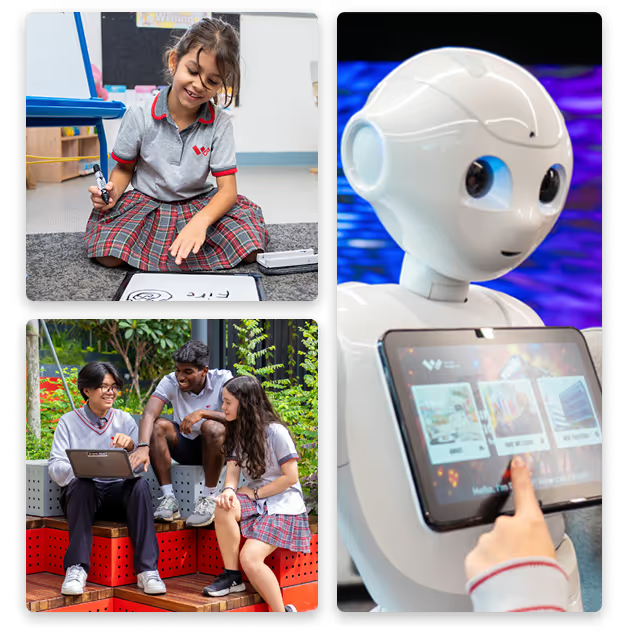


In our school community technology is ubiquitous. We are privileged to be able to say that all our students from the early years through to secondary use a range of technology applications and hardware in their daily learning. Unlike other educational communities I have worked in, in my role as Director of Educational Technology, I do not need to spend time getting technology tools into the hands of teachers and students. It is already deeply embedded. The real question is, “What are we doing with that technology?” now that it is so widespread. Are our approaches to learning the same as always with the exception of a very expensive pencil, or does the technology allow for transformation?
Seymour Papert, the MIT mathematician and computer scientist who pioneered artificial intelligence and created Lego Mindstorms, was a big advocate of computers in education. He believed computer-based games and applications provided a fundamentally important opportunity for true learning that school did not. Computer-based learning has the potential to create opportunities for what he called “hard fun” (Papert, 1998). What he meant by this was that creation tools and games available on a computer were fun because they were hard. Papert was thinking and writing about this idea in the 1990s. Today the narrative from educational thought leaders is that we need more problem-based learning, design thinking, STEAM activities, and coding in our classroom. I agree, but we cannot authentically add these into our curriculum without removing something to make room. This is where we need to have a long and challenging discussion about technology integration. So, I will return to my original thought, which is, do we want to just substitute our old technology (pencil, paper, textbook, chalkboard) for the latest technology (laptop, internet, wifi-enabled digital whiteboard), or do we actually want to leverage the fantastic tools now available to offer a different learning journey for our children and youth? If the answer is yes, then we need to let go of the traditional notion of school as a homogenous compliance-based experience, while continuing to “remember” (Hargreaves, 2007, p.226) what we know about learning, and embark on a new vision of the school. Papert already knew, thirty years ago, that computers offered this new paradigm for learning.
Papert saw through his research into kids and computer games that learning was essentially hard and that it was best when learners were “deeply engaged in hard and challenging activities” (Papert, 1998). Computer games offered an incentive to build mastery and were an incentive for children to learn independently on their own terms. Because a video game has a clear structure (beginning, middle, and the end), it delineates the learning process and makes learning tangible and real for the learner. Finally, a game allows the learner to be in charge of the process, own their learning, and not simply complying with the requests of an adult teacher. Compliance is no way to become a lifelong learner.
Papert was thinking about these approaches to learning thirty years ago when computers were relatively limited in scope compared to what is available in our school today. Our students have a direct connection to the world’s collective knowledge, real-time collaborative writing and presentation tools, a movie and recording studio, and a multitude of applications to challenge and create learning experiences. The point here is not that students should be playing video games in school. Instead, approaches to learning and new pedagogies offered by our rich technology landscape should be leveraged and forefronted.
How can you integrate tech into your classroom? Start by accepting the idea, that to add something new, we must let go of some aspects of the old school model that have been made redundant by modern tools.
Patrick Holt
Director of Educational Technology
Works cited
Hargreaves, Andy. “Sustainable Leadership and Development in Education: Creating the Future, Conserving the Past.” European Journal of Education, vol. 42, no. 2, 2007, pp. 223–233. Papert, Seymour. “Does Easy Do It: Children, Games, and Learning.” Papert.org June 1998, papert.org/articles/Doeseasydoit.html. Accessed 19 Nov. 2020.