

With so many factors to consider, choosing the right international school for your child can be an overwhelming process.
While there’s no doubt that international schools offer high-quality education, parents have to weigh a lot of information — such as the school’s curriculum, location, tuition fees and more — before they make a decision.
On top of this, a school that’s right for one child may not be right for your daughter or son.
While some children thrive in a rigorous/academically-focused school environment, others succeed within a school with a more balanced, holistic child-centred approach.
Knowing how your child learns best, and in which type of school environment they will succeed in, is critical when choosing the right school.
To help you make the best decision for your child, check out the infographic below to know some important considerations when choosing an international school in Singapore.
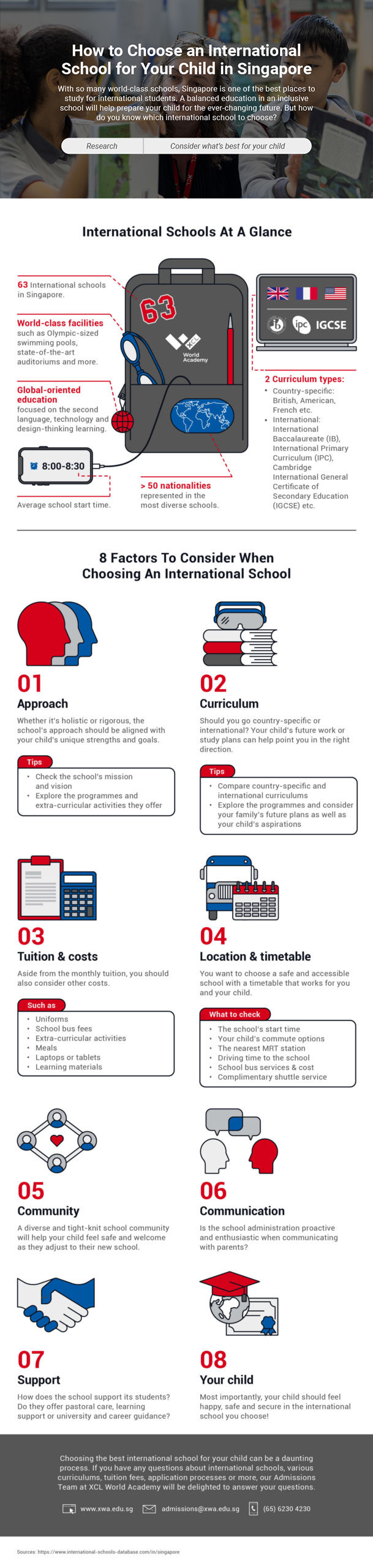
Read on for more information on each factor, or click on each link to jump to a specific section.
- Teaching Approach
- Curriculum
- Location and Timetable
- Community
- Communication
- Support
- Tuition Fees & Miscellaneous Costs
- Your Child
1. Teaching Approach
International schools are known for providing high-quality education, but the way they approach teaching can vary significantly from school to school.
Some put a strong emphasis on academic performance, while others offer a balanced curriculum with equal attention to academics, sports, arts and the social-emotional needs of each child.
The best approach will depend on your child’s unique needs, including their interests and learning style.
Aside from the school’s teaching approach, it’s also important who your child’s teachers will be. This doesn’t mean you have to meet them all during the admissions process. However, it’s good to know their qualifications and experience, as these have a direct impact on your child’s education.
Sending your child to an international school means they’ll be taught by highly qualified and experienced educators, often from different parts of the world. Choosing a school with world-class faculty will influence more than just your child’s academic performance; it also means they’ll form strong bonds with supportive teachers who want to see every child succeed.
Consider asking the following questions when you visit the school or speak with the Admissions Team:
- What are the school’s vision, mission and values?
- What is a regular day at the school like?
- Do teachers personalise their lessons for students?
- Does the school offer learning support?
- What extra-curricular activities are offered?
- How does the school prepare students for the future?
- How does the school screen their teachers?
- What qualifications do the teachers have?
- How do teachers support their students inside and outside the classroom?
While some of these questions can be answered by an online search, some are best answered by the school’s Admissions Team.
Booking a private campus tour is the best way to learn more about the school while seeing its approach in action. You can also schedule a virtual tour if you are looking for a school while overseas.
2. Curriculum
For many parents, the curriculum is the most important thing to consider when choosing an international school. That’s because the curriculum you choose has a direct impact on your child’s educational experiences and higher education pathways.
For example, if the school you choose follows an American curriculum, your child will have an easier time transitioning to an American school or university in the future.
Some families also choose schools based on their home country’s curriculum, so that their child can learn in a familiar setting while adjusting to their new home in Singapore.
On the other hand, an international curriculum — such as the International Baccalaureate (IB) — provides greater flexibility and familiarity for families who move around often. This curriculum is not only highly regarded by universities and colleges all over the world but also prepares students to become well-rounded global citizens.
It’s important to remember that there’s no one best curriculum. Instead, you have to balance academic and practical aspects when making your decision.
3. Location and Timetable
While most parts of Singapore are easily accessible, you want to ensure that the school is safe, secure and easy to reach by car or public transport. Additionally, you’ll want to check:
- the school’s distance from your home,
- whether they offer bus or shuttle options,
- how long the commute takes, and
- what time does the school day start.
Some schools also offer transportation to extra-curricular activities right after school, while others host extra-curriculars onsite. The key is to find the most convenient option for your family while ensuring your child’s comfort and safety.
Knowing your child’s transportation options and the school’s start time, will help you make an informed decision. These practical considerations will affect your child’s daily routine — so you’ll want to research them carefully.
4. Community
Does the school foster a sense of community?
Whether your family is new to Singapore or not, a close-knit community can offer support, new friendships (for both children and parents!) and many other benefits.
Many schools will hold engagement sessions, cultural fairs, family fun days and other events to encourage parent involvement. These events are not only great for meeting other families but also for bonding with your child.
You should also consider how diverse the school community is.
Attending a diverse international school will benefit your child academically and socially, as they’ll learn how to connect with people from all over the world and become more empathetic toward others. Plus, they can stay connected to their culture while learning about other languages and traditions.
5. Communication
Does the school openly communicate with parents and guardians?
It’s important that you are informed regularly about your child’s performance as well as their well-being at school.
Parent-teacher conferences are one way to stay updated, but school communication shouldn’t end there. When speaking with admissions teams, ask how — and how often — the school’s leadership and teachers communicate with parents.
It’s also a good idea to check the school’s official channels, including their parent portal, website, blog or any official publications. This will give you a better idea of the school’s philosophy, policies, programmes and recent achievements.
6. Support
Many international schools offer comprehensive support programmes, such as pastoral care, learning support, guidance counselling and more. This helps create an inclusive learning environment that caters to every student’s needs.
Some schools also implement personalised learning and focus on each student’s unique goals and abilities. These programmes will help ensure that your child stays happy, motivated and excited to learn at school.
7. Tuition Fees & Miscellaneous Costs
It’s no secret that sending your child to an international school can be quite costly. Aside from tuition, you may also need to pay for uniforms, transportation, meals, learning materials and extra-curricular activities.
Listing down the tuition and other fees can help you determine if a school is within your budget. All of these ‘extra’ costs should be added together in order to properly compare each of your short-listed schools.
Many families only consider the costs involved for the first year of entry, however, this can be a costly mistake. Tuition fees increase aas your child grows older, and each school can have very different tuition fee pricing structures.
Look at the total expected cost of education at each school (the ‘lifetime’ cost of education) by adding-up all the fees from the entry grade through to the expected exit grade, allowing also for price inflation each year.
By comparing the ‘lifetime’ cost of education across different schools, you can better assess the best value-for-money option that matches your child’s learning needs, with the highest quality education within your budget.
8. Your Child
More than anything else, your child should feel safe, secure and happy at school. As you go through the research and admissions process, don’t forget to ask for their input.
What kind of school do they want to attend?
You should also consider their unique strengths and talents.
For example, if your child is good at sports, you’ll want to choose an international school with competitive sports programmes. If your child is academically inclined, a school that offers a rigorous curriculum will keep them engaged and motivated. If your child is a natural all-rounder, they will thrive in an IB-through learning environment that nurtures both their IQ and their EQ.
Ultimately, the best international school is the one that will help your child prepare for (and succeed in) the future.
XCL World Academy – Experience Personalised Learning And Diversity
As a parent, choosing a school for your child is one of the biggest decisions you will make. It’s important to do your research and weigh all the factors carefully to make the best decision for your family.
While practical considerations will always exist, the school’s culture and approach are just as important to look at. At the end of the day, the best international school is one where your child feels safe, secure, happy, and motivated to learn every day.
At XCL World Academy, we offer a rigorous and balanced education for students aged 2 to 18, beginning with our Nursery programme and continuing through the full International Baccalaureate (IB) continuum of studies.
We also offer competitive sports programmes, an active arts culture, modern and spacious facilities, and a highly engaged parent and student community.
We believe in future-proofing your child by providing relevant skills and exposures, equipping them with the skills required for the jobs of tomorrow.
透過我們世界級的課程,並在經驗豐富的老師指導下,您的孩子將踏上一段啟發人心的教育旅程,成長為一個全面發展且富有同理心的年輕個體。
如果您想進一步了解 XCL World Academy,並評估我們是否適合您的孩子,歡迎 與我們聯繫 討論您孩子獨特的需求與期望。我們的招生團隊將很樂意協助您找到最適合您家庭的學校。